Past Midnight, the Screens Went Dark
Just after midnight on March 11, 2026, employees at Stryker Corporation, one of the world's largest medical device manufacturers, started noticing their devices going dark. Laptops wiped clean. Login pages replaced with a new logo they did not recognize. Servers across offices on multiple continents suddenly unreachable. By the time the sun came up, the scale of what had happened was becoming clear: more than 200,000 systems, servers, and mobile devices across 79 offices worldwide had been wiped, and roughly 50 terabytes of company data was gone from Stryker's network and, the attackers claimed, now in theirs.
The group behind it did not stay quiet. Within hours, a threat actor calling itself Handala posted a lengthy statement on Telegram taking responsibility, and the reason it gave had nothing to do with money.
A Retaliatory Strike, Not an Extortion Attempt
Most of the ransomware and data theft attacks covered in security news follow a familiar financial logic: get in, steal or encrypt something valuable, demand payment. The Stryker attack followed a different one entirely. Handala's own statement framed the operation as retaliation for a missile strike that had occurred less than two weeks earlier, on February 28, 2026, which destroyed the Shajareh Tayyebeh girls' elementary school in Minab, in southern Iran. Reporting at the time put the toll at around 180 people killed and 95 injured, the majority of them schoolchildren.
Handala has been publicly linked by multiple security researchers and government statements to Iran's Ministry of Intelligence, and its operations throughout 2026 have consistently followed this pattern, framing cyberattacks against Western and Israeli-linked companies as direct responses to specific real-world events. Why Stryker specifically? Current reporting points to two likely reasons. Stryker holds a roughly $450 million medical supply contract with the United States military, and in 2019 the company acquired Orthospace, an Israeli medical technology firm. For a group explicitly organizing its campaign around retaliation, that combination made Stryker a symbolically loaded target, not just a convenient one.
How the Attackers Actually Got the Job Done
What makes this incident particularly worth understanding, beyond its geopolitical framing, is the mechanism. Security researcher Kevin Beaumont, who has tracked the incident closely, described how Handala appears to have gained access to Stryker's Active Directory environment and then used Microsoft Intune, the company's own legitimate endpoint management tool, to remotely wipe Microsoft devices across the organization. That included devices enrolled under Stryker's bring-your-own-device policy, meaning employees' personal phones and laptops were swept into the wipe alongside company-owned hardware.
This is the detail that should make every IT and security team pause. The attackers did not need to write custom wiper malware and get it past endpoint protection on 200,000 separate machines. They compromised the identity and device management layer that already had the authority to reach every one of those devices, and let the company's own infrastructure do the rest. Once someone controls Active Directory and the enterprise mobility management platform tied to it, they are not breaking into the network anymore. They are already the administrator.
In Stryker's own regulatory disclosures, the company said its investigation, conducted alongside Palo Alto Networks' Unit 42 and other outside experts, found that the malicious file used to run commands during the intrusion was not capable of spreading further, either inside the network or beyond it, once discovered. That is a genuinely useful containment detail. It does not undo the fact that the initial access and privilege level the attackers achieved was severe enough to reach the device management system covering the entire company.
The Paper Trail, and What It Shows
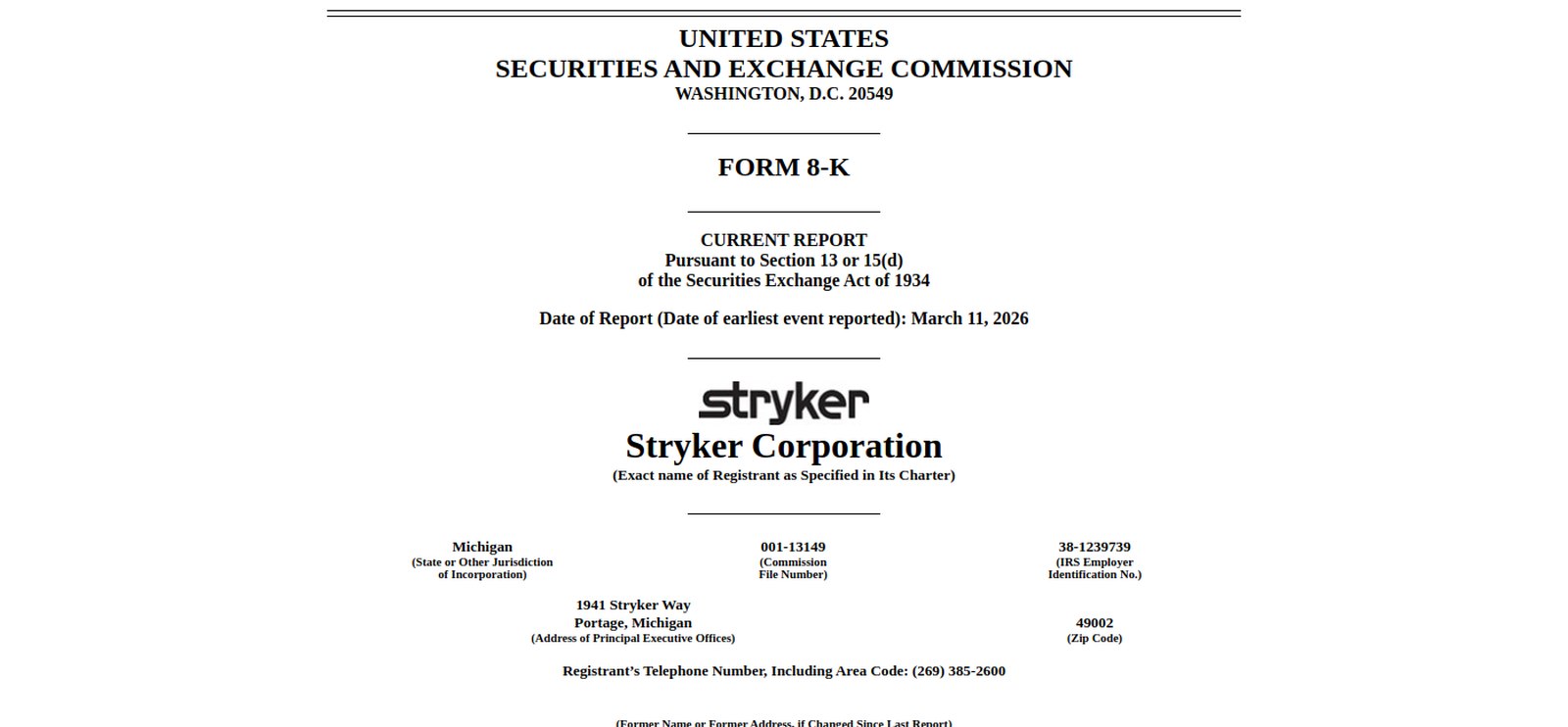
Because Stryker is a publicly traded company, its response had to happen partly in public. The company filed an 8-K with the Securities and Exchange Commission on the day of discovery, then follow-up filings on March 12 and again on March 23 as the investigation progressed. That paper trail is worth reading if you want to see how a well-resourced company actually walks through this kind of event in real time: activate the incident response plan, bring in outside forensics and threat intelligence specialists immediately, assess for ransomware or further spread, and communicate what is known and not yet known to regulators and shareholders on a rolling basis rather than waiting for a complete picture.
Stryker's early filings said the company had no indication of ransomware or further malware spread and did not believe the incident was reasonably likely to have a material impact on full-year guidance. Later reporting on the company's first-quarter results told a more complicated story, with the incident's operational disruption showing up in actual financial performance. Both things can be true. An early assessment made in the first days of a crisis, based on the best available evidence at that moment, does not always match what the full scope of a 200,000-device, 50-terabyte incident ultimately costs once the dust settles weeks later.
What This Means Beyond One Company
It is tempting to read the Stryker attack as a one-off, a company caught in the crossfire of a specific geopolitical moment. That would miss the actual lesson. Nation-state and nation-state-adjacent groups increasingly treat commercial companies, particularly ones with defense contracts, dual-use technology, or ties to countries involved in active conflicts, as legitimate targets for retaliation, not just espionage. That calculus does not require your company to be a defense contractor in the traditional sense. A hospital equipment supplier with a military contract line item, a firm with an acquisition history that touches the wrong geography, or simply a recognizable global brand can be enough.
The technical lesson matters just as much as the geopolitical one. Identity infrastructure and endpoint management platforms are, by design, the most powerful tools inside a modern IT environment, because they are built to reach everything. That is exactly what makes them the highest-value target for an attacker who wants maximum damage with minimum custom tooling. Protecting Active Directory, enterprise mobility management, and the accounts with administrative rights over them deserves the same level of scrutiny, monitoring, and access control as your most sensitive financial systems, because functionally, they now are your most sensitive systems.
What Organizations Should Take From This
Treat identity and device management platforms as crown jewels, not IT plumbing. Multi-factor authentication, conditional access policies, and tightly limited administrative accounts on Active Directory and any enterprise mobility management platform should be non-negotiable, monitored continuously, and reviewed far more often than most organizations currently manage.
Segment administrative access so that no single compromised account can reach every device in the company at once. If a help desk technician's credentials can trigger a fleet-wide remote wipe, that is a design flaw waiting for exactly this kind of incident.
Keep offline, verified backups of the data that would hurt most if 200,000 devices went dark tomorrow. A wiper attack has no ransom negotiation to fall back on. Recovery depends entirely on what you already had squared away before the attack happened.
Understand your organization's actual geopolitical exposure. Government contracts, acquisitions in politically sensitive regions, and brand visibility all factor into whether your company looks like a symbolic target to a retaliation-driven group, and that risk profile deserves to be part of your security planning conversation, not treated as somebody else's problem.
At AetherGuard Technologies, we help organizations lock down exactly the kind of identity and device management infrastructure that made this attack possible at Stryker, along with the backup and incident response planning that determines how fast a company gets back on its feet when prevention alone was not enough.