The New Infrastructure Nobody Finished Securing Yet
Every major wave of new technology brings the same tradeoff. Companies race to adopt it, developers ship it faster than security teams can review it, and for a while the new category of software runs a little ahead of the security maturity that older, more established infrastructure already has. Right now, that category is AI infrastructure, specifically the gateway and proxy layers that let companies plug their applications into large language models without hand-rolling the integration for every provider. LiteLLM is one of the most widely used tools in that category, and in 2026 it became a live demonstration of exactly this problem.
What LiteLLM Actually Is
LiteLLM is an open source proxy server, often described as an AI gateway, that sits between a company's applications and the various large language model providers they use. Instead of writing separate integration code for OpenAI, Anthropic, and every other provider a company relies on, LiteLLM exposes a single, unified, OpenAI-compatible API and handles the translation underneath. It has become genuinely popular infrastructure precisely because it solves a real, tedious problem, and popularity in security terms means one thing above all else: a very large number of organizations are now running the same piece of software, which makes a critical flaw in it worth an enormous amount to whoever finds it first.
The Vulnerability Chain, Explained Plainly
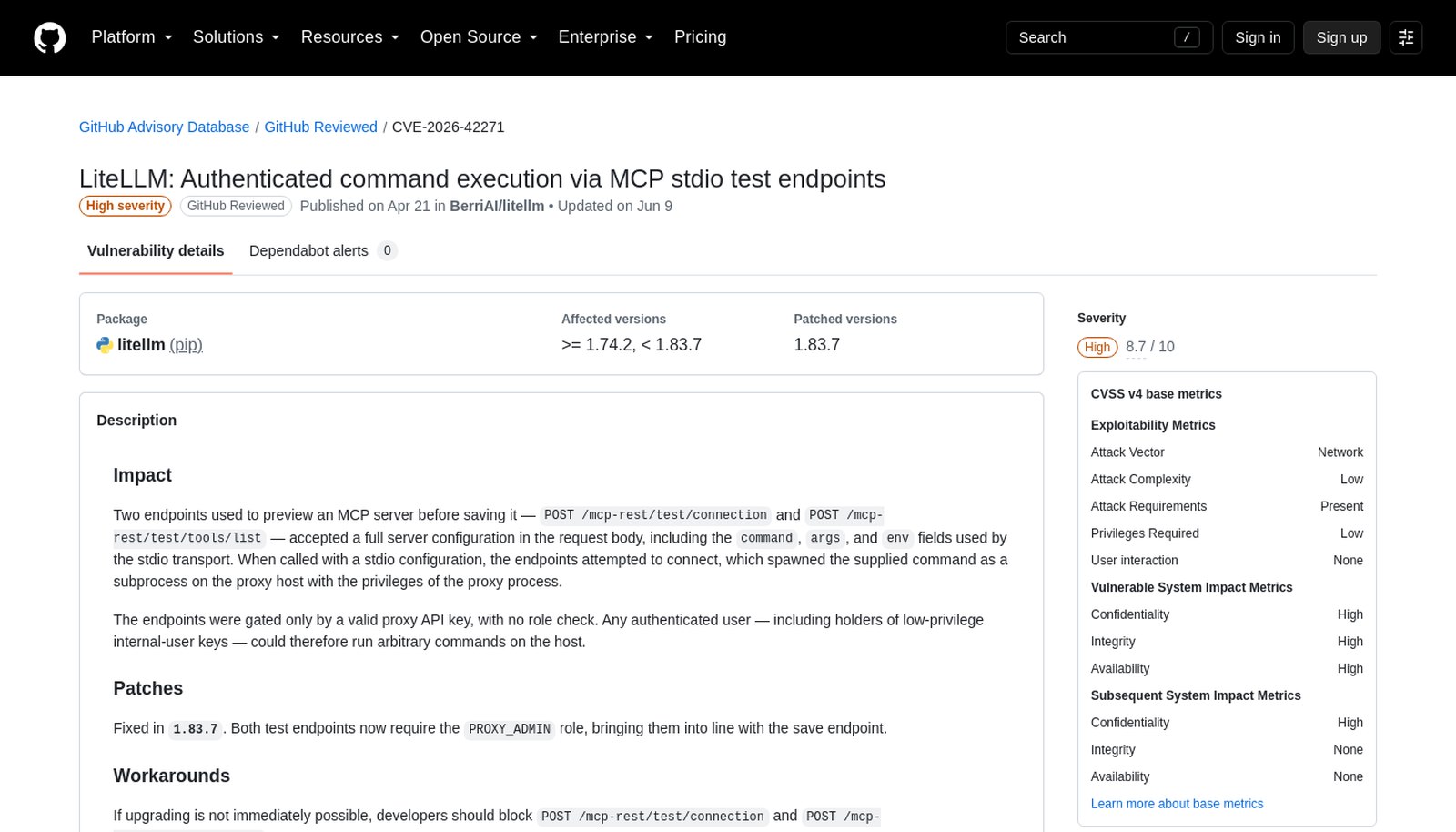
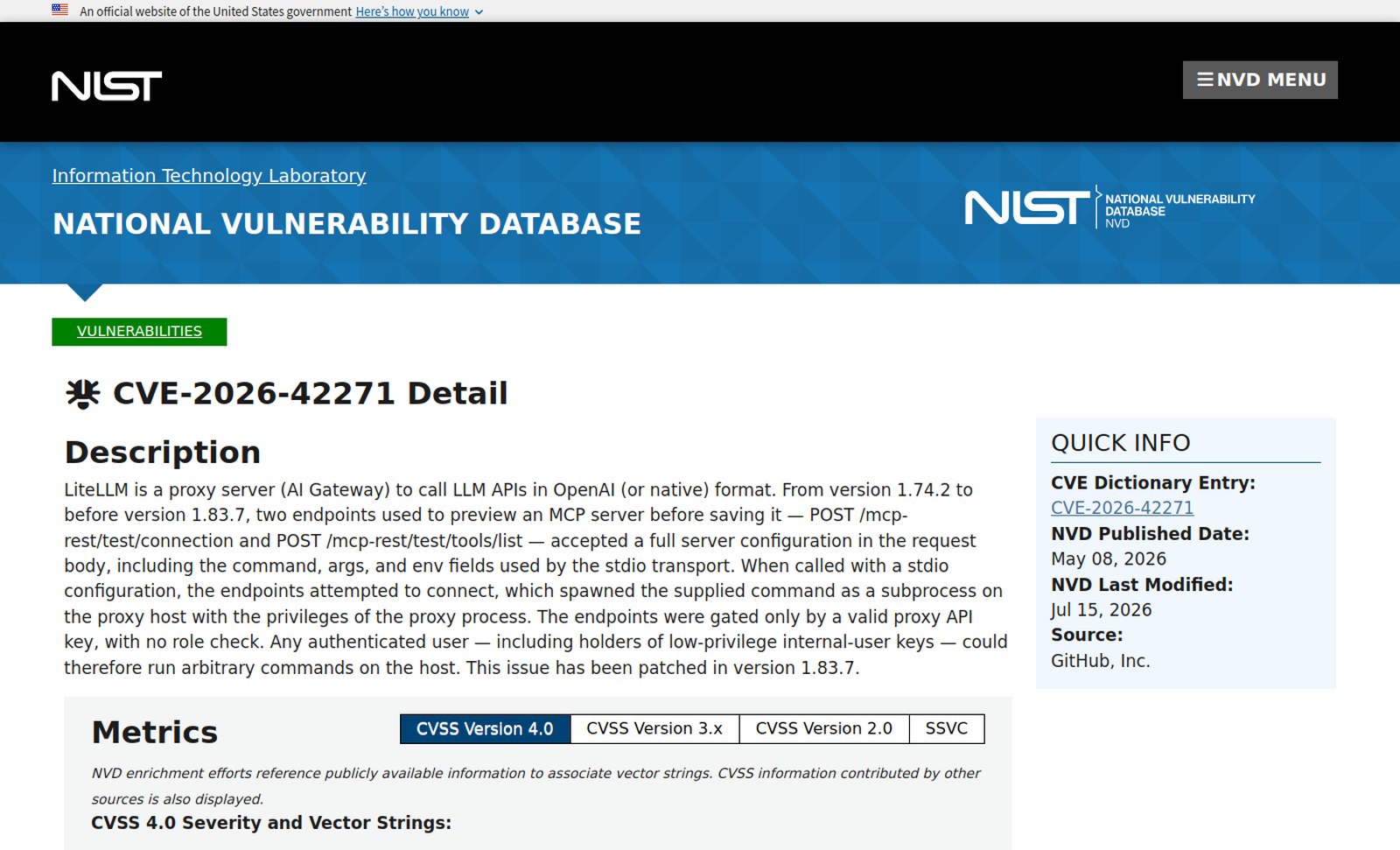
CVE-2026-42271 lives in two endpoints LiteLLM built to let users preview a Model Context Protocol server configuration before saving it, POST /mcp-rest/test/connection and POST /mcp-rest/test/tools/list. Both endpoints accept a full server configuration in the request body, including command, argument, and environment fields used by the stdio transport method. The problem is that when called with a stdio configuration, these endpoints actually attempt to connect using it, which means they spawn whatever command was supplied as a live subprocess on the machine running the proxy, with the same privileges the proxy process itself has.
On its own, this required a valid LiteLLM API key, earning it a high severity score of 8.7. But the endpoints were gated only by having any valid key at all, with no check on what role or privilege level that key belonged to. Any authenticated user, including someone holding only a low-privilege internal key meant for routine application use, could reach these endpoints and run arbitrary commands on the host.
Then came CVE-2026-48710, a Host Header validation bypass, nicknamed "BadHost," in Starlette, the web framework LiteLLM is built on. Chained together, the two vulnerabilities let an attacker skip the authentication requirement entirely. The combined attack chain earned a CVSS score of 10.0, the maximum possible, turning a bug that needed insider-level access into one that needed nothing at all.
The full technical breakdown lives in GitHub's own Security Advisory Database, under GHSA-v4p8-mg3p-g94g, published directly by LiteLLM's maintainers alongside the fixed release.
From Disclosure to Ransomware in Weeks
CISA added CVE-2026-42271 to its Known Exploited Vulnerabilities catalog on June 9, 2026, confirming that exploitation was no longer theoretical. Not long after, researchers linked exploitation of this exact chain to threat actors associated with Qilin, also tracked as Agenda, one of the more prolific ransomware operations active in 2026. Qilin runs a familiar playbook: gain initial access, move to establish persistence and escalate privileges, then deploy ransomware and, frequently, steal data first to apply double extortion pressure regardless of whether the victim can restore from backup.
What makes the LiteLLM chain a particularly attractive entry point for a group like Qilin is exactly what makes AI gateways valuable in the first place. A LiteLLM deployment sits centrally inside an organization's infrastructure, with the ability to spawn subprocesses on its host, and often holds or has adjacent access to API keys, credentials, and configuration data for every AI provider and internal service the company uses. Compromising the gateway is not just one foothold among many. It is a foothold sitting unusually close to the center of the network, with elevated trust already built in by design.
The Fix, and Why "Just Patch It" Is Not the Whole Story
LiteLLM shipped a fix in version 1.83.7, adding a requirement that only accounts with the PROXY_ADMIN role can access the previously open test endpoints, and updating the vulnerable Starlette dependency to a version that closes the Host Header bypass. Affected versions ran from 1.74.2 through 1.83.6, a wide window that likely covers a large share of real-world deployments given how quickly this category of tooling gets adopted and how infrequently it gets revisited once it is working.
Patching closes the door, but it does not answer the harder question sitting underneath this incident: how many organizations running LiteLLM even know they are running it, in what version, and whether their instance has already been probed or compromised in the weeks between disclosure and today. AI tooling in particular tends to get deployed by individual engineering teams moving fast to ship a feature, often outside the normal software inventory and patch management process that more established infrastructure goes through. It is entirely possible for a company's security team to have no idea a LiteLLM instance exists in their environment at all until an incident forces the conversation.
Why This Story Matters Beyond One Piece of Software
The LiteLLM chain is a preview of a pattern that is only going to become more common. As companies race to adopt AI capabilities, they are pulling in an entire new layer of infrastructure, gateways, orchestration frameworks, vector databases, agent frameworks, at a pace that outstrips the security review most other categories of software eventually receive. Much of it is open source, built quickly by small teams solving an urgent, popular problem, which is exactly the profile of software most likely to ship a critical flaw and also most likely to get adopted everywhere before anyone circles back to audit it properly.
None of that is a reason to avoid AI infrastructure. It is a reason to bring the same discipline to it that mature organizations already apply to every other piece of infrastructure touching sensitive data and holding elevated privileges.
What Organizations Running AI Infrastructure Should Do
Inventory what AI tooling is actually running in your environment right now, including anything individual teams may have stood up on their own outside a formal procurement or review process. You cannot patch or monitor infrastructure your security team does not know exists.
Patch LiteLLM to 1.83.7 or later immediately if you are running an affected version, and treat any instance that has been internet-facing during the exploitation window as a possible compromise until your investigation says otherwise.
Apply the principle of least privilege to API keys the same way you would to user accounts. A key meant for a routine application task should never be able to reach administrative or test endpoints capable of spawning subprocesses on the host.
Monitor AI gateway and proxy infrastructure for unusual subprocess creation, unexpected outbound connections, and requests to administrative or testing endpoints from sources that should never be calling them. This is exactly the kind of infrastructure that benefits from behavioral monitoring rather than relying on authentication alone as the only line of defense.
Treat new categories of infrastructure, AI tooling very much included, with the same vendor and vulnerability management rigor applied to everything else touching your network. Being new and exciting does not exempt a piece of software from being exactly the kind of target a ransomware group is actively hunting for.
At AetherGuard Technologies, we help organizations build an accurate inventory of the infrastructure actually running in their environment, AI tooling included, and put the patch management, access controls, and monitoring in place before a chain like this one turns into a ransomware incident rather than a footnote.